
From Idea to Startup: What 90 Days of Building Looks Like
From Idea to Startup: What 90 Days of Building Looks Like

Almost every student we meet has an idea sitting somewhere in their notes app. A campus problem they keep complaining about. A side project they've thought about "someday." What separates the ones who actually build something from the ones who don't usually isn't talent; it's whether anyone ever showed them the actual steps. That's really what startup building for students comes down to, and it's what we try to make concrete over a focused 90-day stretch.
We won't pretend this is a fast track to overnight success; it isn't, and anyone who tells you otherwise is selling something. What it is is a realistic look at what disciplined, mentor-backed building looks like, week by week, for a student in Kolkata (or anywhere else) who's ready to stop planning and start shipping.
Why 90 Days, Specifically?
Ninety days hits a sweet spot. It's long enough that "I have an idea" has to turn into something you can actually show someone. And it's short enough that you can't keep hiding behind research forever.
Honestly, in our experience running cohorts with students from Kolkata and the surrounding areas, the thing that trips people up almost never turns out to be skill. It's momentum. Give a student an open-ended timeline and months go by with nothing to show. Give them a fixed 90-day window with weekly deliverables and a mentor checking in, and suddenly there's a working project by the end.
This lines up with where Indian education policy has been heading too. The National Education Policy (NEP) 2020 pushes hard for experiential, skill-based learning instead of pure theory, and that's more or less the philosophy our cohort structure is built around.
So What Actually Happens During Those 90 Days?
Weeks 1–3: you validate before you build. Students go talk to real people. Not friends who'll say "yeah, sounds cool," but actual potential users. The question they're really testing is: would someone pay for this? A lot of ideas shift shape here, and that's not a failure; that's the process working.
Weeks 4–9: this is where the building happens. Technical skill matters a lot at this stage, which is exactly why our MERN Stack Mastery program exists. Students work with MongoDB, Express, React, and Node.js to build something that actually runs, not just a deck full of mockups. When we've watched this play out across recent cohorts, students building their MVP with MERN while solving their own startup problem tend to move faster than students learning the stack in isolation because they're not writing throwaway exercises; they're solving something they actually care about.
Weeks 10–12: students ship and face real feedback. They put the MVP in front of actual users, and quite a few land their first customer, paying or not. This part is genuinely uncomfortable, and it's meant to be. Public feedback stings more than private practice, and that's a skill worth learning early rather than at 25.
How Do You Actually Turn an Idea Into a Startup?
If we're being honest, it's less about being clever and more about showing up consistently. The students who make real progress aren't necessarily the ones with the most original idea; they're the ones who take entrepreneurship skills for students (pitching, prioritizing what matters, handling rejection without spiraling) as seriously as they take the code itself. It's not far from the design-thinking loop taught at places like Stanford's d.school: empathize, define, ideate, prototype, test; over and over, not once.
One honest caveat: not every idea deserves to become a startup, and not every sprint ends in a launch. Some students realize mid-cohort their idea needs more validation, or that a different track — Future CEO, say, or Financial Intelligence, actually fits them better. That's a fine outcome. It's not a setback.
Startup Ideas Worth Actually Testing
The strongest first ideas usually come from a problem the student has lived through personally, a gap in how their campus runs, an inefficiency at a local business, something their own friend circle keeps complaining about. Small, specific, local problems are simply easier to test than big abstract ones, especially the first time around.
Ready to Build Something Real?
If you're a student or a parent weighing options for one, looking for more than another theory-heavy course, Edufy's MERN Stack Mastery program is where ideas actually turn into shipped products. Live, mentor-led cohorts built for beginners and future founders alike.
Talk to a mentor and explore the MERN Stack Mastery program →
Frequently Asked Questions
Do I need to already know how to code?
No. The program is built for beginners; the technical skill grows alongside the startup project, not before it.
Will this fit around school or college?
Yes. Cohorts run live on a weekend/part-time schedule designed specifically around a student's calendar.
What do I actually leave with?
A working MVP built on the MERN stack, direct mentor feedback, and hands-on experience validating and pitching a real idea — skills that hold up whether or not that specific startup goes anywhere.

How Teamwork Skills Built in School Predict Startup Success (2026)
Most startups don't fail because of bad ideas — they fail because of broken teams, and that pattern often starts in school group projects. E
Read story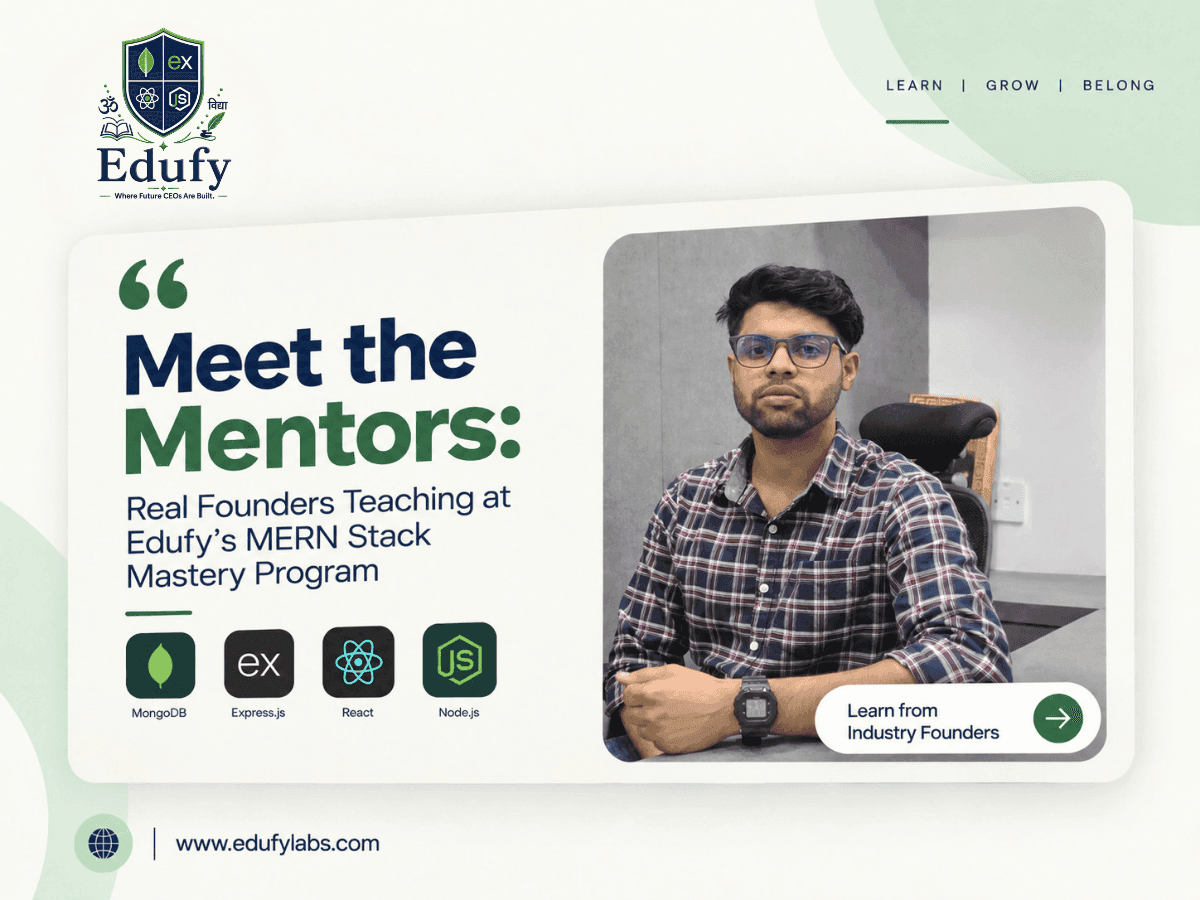
Meet the Mentors: Real Founders Teaching at Edufy's MERN Stack Mastery Program
Meet the Mentors: Real Founders Teaching at Edufy's MERN Stack Mastery Program
Read story
Beyond ChatGPT: The AI Skills Students Actually Need for Their First Job
Knowing how to prompt ChatGPT isn't the differentiator it used to be. This breaks down the actual AI skills recruiters screen for in 2026 —
Read story